How to Drive Revenue Growth Through Design Thinking
How to Drive Revenue Growth Through Design Thinking
July 2019
1. Why Focus on Revenue Growth
1.1 The Design Bottleneck in Mature Products
"Our game has been around for over a decade. The habits of our existing users are deeply ingrained and highly resistant to change — there's barely any room for innovation, and the interfaces we design feel like they carry little real value."
Every designer who has worked on a mature product has had some version of this thought.
Every game has its own lifecycle — from introduction, through growth, into maturity, and eventually decline. Each phase calls for a different design focus.
During the introduction phase, the game is built around a few core mechanics, and designers are essentially constructing everything from scratch. This is where creative thinking flourishes — designers' imagination is what makes the game fun and compelling, attracting players and propelling the product into the next phase: growth.
During the growth phase, gameplay expands rapidly and the demand for design surges. Designers must create differentiated interfaces to capture users and keep the game competitive in an increasingly crowded market.
Once a game enters the maturity phase, the user base stabilizes, and so does the gameplay. Designers must work within established user behaviors, facing more constraints. Many feel their design skills have little room to shine. Yet paradoxically, this is the phase with the greatest commercial value. During introduction and growth, the priority is market capture, not monetization. But in maturity, the primary goal becomes maximizing business value — and improving paid conversion becomes the most critical challenge for the product team. Interface optimization takes a back seat. But what if design could directly drive revenue growth? Wouldn't that be design's greatest contribution?
1.2 Common Misconceptions Among Designers
a. Ignoring the Business
In games, monetization is often assumed to be driven by content — a new legendary weapon draws a wave of high-spending players; a seasonal limited-edition costume triggers a short spike in purchases. Many designers fall into a misconception: "Content is set by the product team. As long as the UI doesn't block the player, design has little to do with paid growth."
This mindset leads designers to disengage from the business metrics of their own product. They don't track conversion rates or purchase rates, which also means they struggle to truly understand what product managers are trying to achieve when discussing design proposals.
In reality, design's value goes far beyond surface polish. Apple dramatically boosted sales simply by offering colorful iMac models. The impact of design on business outcomes is profound.at if design could directly drive paid growth? Wouldn't that be design's greatest contribution?
b. Believing Design Can't Be Measured
Because design involves significant creativity and subjectivity, people often assume design quality is inherently difficult to quantify.
What makes a design good? Is it purely a subjective feeling in the user's mind? Many designers chase visual impact to demonstrate their craft — but design can and should be measured. What designers consider excellent work doesn't always resonate with users. Quality design shouldn't be validated through subjective satisfaction alone; it must be proven through objective metrics like conversion rates. Only when those numbers move can we say users are genuinely responding to the design.
1.3 Shifting from Requirement-Driven to Value-Driven Design
The typical workflow goes like this: a product manager says, "I want to redesign the shop interface," and the designer jumps in and starts executing. But what value does this work actually create? Designers rarely stop to ask. Once the design is done, how do you demonstrate its worth — through vague player feedback? Because the PM thinks it looks nice? Without a measurable standard, this kind of workflow easily traps designers in an endless cycle of reactive execution, year after year.
But if a designer defines a goal — "redesign the shop interface to improve purchase conversion rate" — the design immediately has direction, and its value can be demonstrated objectively through before-and-after data. This is the shift from requirement-driven to value-driven design thinking. It is especially powerful when applied to mature products.
2. Methods for Driving Paid Growth
2.1 Define the North Star Metric
The first and most critical step in growth design is establishing a North Star Metric — also known as the "OMTM" (One Metric That Matters).
Identifying the right North Star Metric means identifying the core value of the product. Every effort should radiate from that core.
The North Star Metric serves two purposes: it guides design direction, and it validates outcomes. When working on paid growth design, you must clarify what metric you're optimizing for — and identify the supporting metrics that signal growth alongside it.
A good metric should meet the following criteria:
A. Does it reflect actual user interaction with the product?
Facebook's North Star Metric is Monthly Active Users — a measure of users who are genuinely engaged. Every iteration Facebook ships is aimed at increasing MAU. MySpace, once the dominant U.S. social platform, used registered user count as its metric. But registrations only go up — they never decrease. Many users registered once and never returned. The difference in how these companies defined success is a key reason Facebook remains the most active social platform in the U.S. today, while MySpace has long faded from relevance.
B. Does it reflect the overall success of the product?
Even when measuring a single system, the metric should align with the product's overall success trajectory. Metrics don't exist in isolation — only metrics that reflect the whole are worth improving.
C. Is it actionable?
The North Star Metric should be grounded in things designers can actually influence — clear and objective, not reliant on subjective judgment. User satisfaction and task completion rates can serve as references, but they shouldn't be the primary metric. Subjective measures are too susceptible to human bias and don't reflect real business impact. Only objective metrics — conversion rates, purchase rates, repurchase rates — can confirm that a design is truly delivering value, and that users are genuinely having a positive experience.
2.2 Break Down the Scenarios
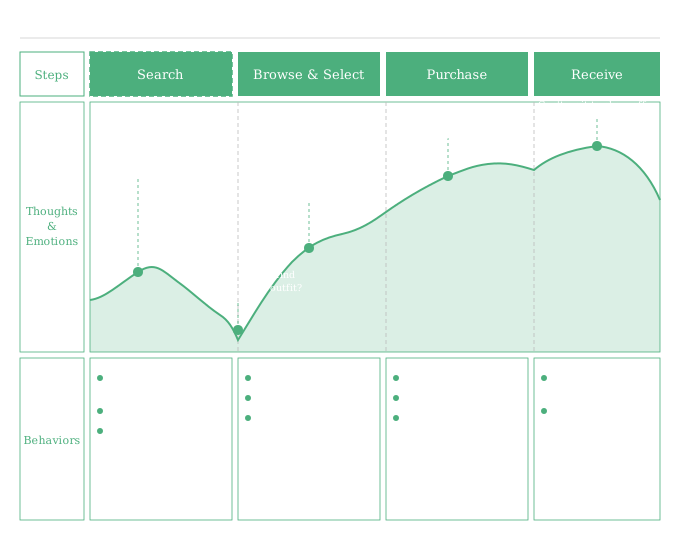
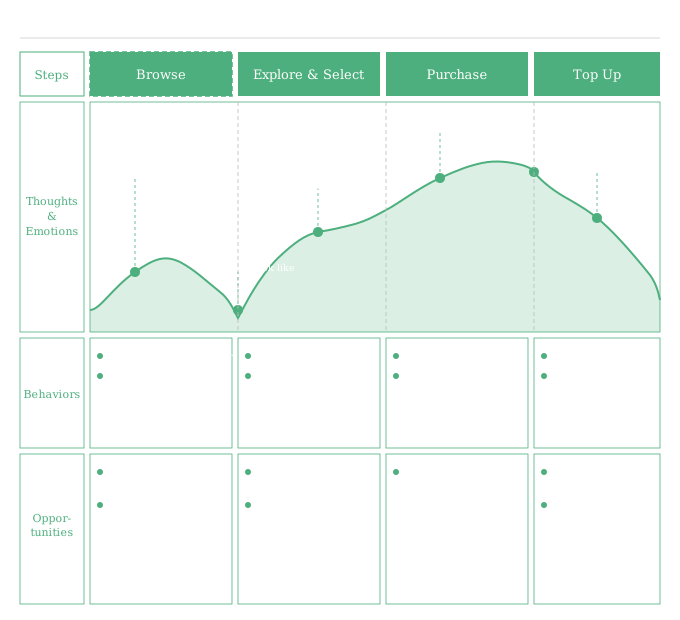
Once a metric is established, you can map the full paid journey and identify the scenarios that contribute to the final metric. At this stage, the goal is to trace the complete user flow and analyze each touchpoint for improvement opportunities.
A user experience map is a useful tool here — it allows you to visualize the entire interaction flow and identify where the bottlenecks or opportunities lie.
Each step in the user journey can be mapped to a corresponding metric, all of which ultimately feed the North Star Metric. For example, in a music streaming app where the North Star Metric is Monthly Active Users, each scenario maps to:
Download the app → Download rate
Register an account → Registration rate
Browse songs → First-browse rate
Listen for the first time → First-listen rate
Return to log in → Retention login rate
Continue listening → Continued listening rate
From these sub-metrics, you can build a growth model:
Monthly Active Users
= New User Activations + Returning User Activations
= (Downloads × Registration Rate × First-Browse Rate × First-Listen Rate) + (Existing Users × Retention Login Rate × Continued Listening Rate)
With scenario mapping in place, you're ready for the next step: design hypotheses.
2.3 Form Design Hypotheses
Based on the growth model, improving any of the sub-metrics on the right side of the equation will drive the North Star Metric upward.
By revisiting each step in the user experience, we can form hypotheses for improving sub-metrics. These hypotheses generate multiple design solutions — but which solution has the greatest impact on the metric with the smallest change required?
For a live product, every data point in the growth model can be tracked and calculated. We can prioritize the sub-metric with the most room to grow, then select the highest-leverage solution — the one with low cost and significant effect — to test first. Once validated, we iterate from there.
In a mature product with a large, habit-formed user base, sweeping redesigns carry high risk. But through small, deliberate iterations — treating every change with rigor — lean thinking can meaningfully drive product value over time.
2.4 Validate with Metrics
Once a design goes live, you validate your hypothesis by observing metric changes. Even something as minor as repositioning a purchase button, if done thoughtfully, will show up in the purchase rate. Any design that moves the needle on product value is a good design.
When reviewing metrics, try to minimize external interference — holidays, new content releases, expansion packs — and keep the conditions before and after as consistent as possible.
Metrics tell you whether an iteration was worthwhile and point the way forward. If the numbers improve, the direction is working and you can continue to optimize and apply the same approach elsewhere. If the metrics are flat or decline, it's time to reconsider and re-hypothesize.
3. Case Study: Shop Iteration in Westward Journey II (Free Edition)
3.1 Identify the North Star Metric
For a game shop, core value lives in the goods it sells. Total sales revenue is clearly the best indicator of shop performance — our North Star Metric. It reflects both the level of user engagement (more active users generate more revenue) and overall product success. It's simple, intuitive, and easy for every team member to understand.
3.2 Break Down the Scenarios
With the metric defined, we mapped out the user experience step by step. Analyzing each touchpoint revealed pain points and opportunities for improving the metric.
From this analysis, we decomposed the abstract goal — total sales revenue — into a growth model of scene-level sub-metrics:
Total Revenue = Traffic × Conversion Rate × Average Order Value = Exposure Rate × Click Rate × Order Rate × Successful Payment Rate × Average Order Value
In terms of what designers can directly influence, the sub-metrics break down by scenario:
Discovery scenario → Exposure rate
Selection scenario → Click rate
Purchase scenario → Order rate and successful payment rate
Growth is driven by improving user experience at each of these stages.
3.3 Design Hypotheses
Working from the scenario analysis and growth model, we developed multiple hypotheses and solution variants for each sub-metric.
Discovery Scenario — Increasing Product Exposure
Hypothesis 1: Exposure doesn't have to be limited to the shop — surface items in other parts of the game to increase visibility.
Solution 1: Allow players to view other players' outfit combinations while wandering the game world, creating organic word-of-mouth product discovery. Players can choose whether to make their look visible to others. Seeing another player's outfit can spark curiosity and motivate a visit to the shop.
Solution 2: Add a one-tap "try on friend's outfit" button in the friend chat interface. Clicking it takes the player directly to the shop's try-on screen for that look, creating a seamless path from social interaction to purchase.
Selection Scenario — Improving Click Rate
Hypothesis 2: Reducing the burden of choice while browsing increases click rate through personalized recommendations.
Hypothesis 3: Surfacing promotional information in context motivates more clicks.
Solution: Redesign the recommendation page to prominently feature promotional bundles and newly listed items.
Hypothesis 4: The social prestige from owning desirable items boosts repurchase intent for that user, while also encouraging others to explore.
Solution 1: Provide a convenient sharing entry point from equipment upgrade and gacha screens, giving players an easy way to show off the results of their purchases.
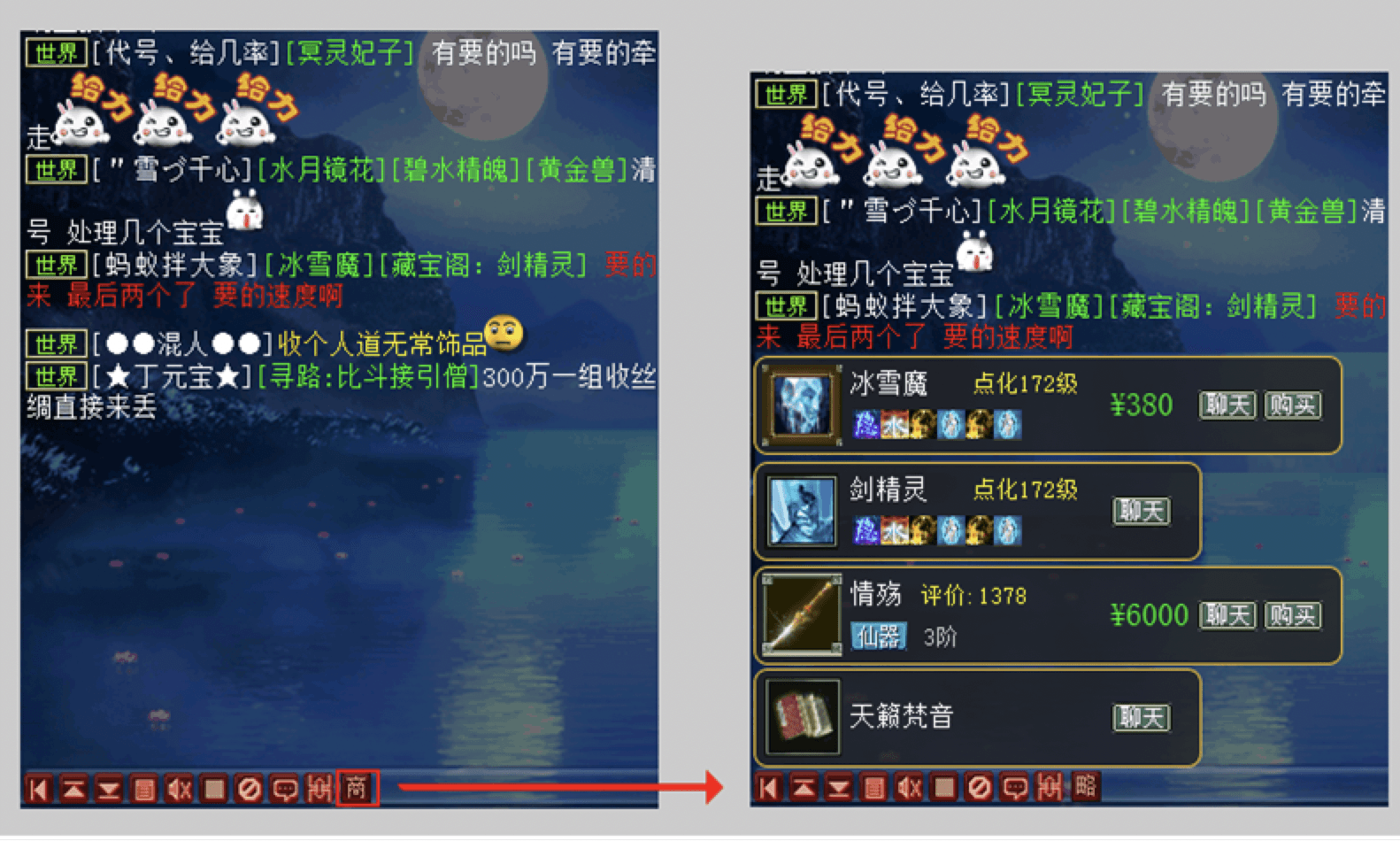
Solution 2: Redesign how equipment is displayed in chat, surfacing outstanding stats more prominently so other players can immediately see the value of high-tier gear.
Hypothesis 5: Helping players quickly resume an interrupted shopping session improves purchase completion.
Solution: Add a try-on history list so players can easily return to and compare outfits they've tried before, reducing friction in the path to purchase.
Purchase Scenario — Improving Order Rate
3.4 Validate with Metrics
Based on the actual situation in Westward Journey II (Free Edition), we prioritized the solutions targeting the discovery and purchase scenarios. After the changes went live, costume sales in the shop showed a steady, sustained increase — validating our design hypotheses. The same methodology was subsequently applied to another game, Voyage of the Golden Age.
4. Case Study: Monetization System Iteration in Voyage of the Golden Age
4.1 North Star Metric: Average Daily Recharge per User
For the n-game store's monetization system, core value is reflected in what players spend. The corresponding metric — average daily recharge amount per user — is our North Star Metric. It captures both user engagement (more active users recharge more) and overall product health. It's also straightforward and easy for the full team to work with.
4.2 Break Down the Scenarios
Through hands-on experience and analysis of the consumption flow in Voyage of the Golden Age, we mapped out the following journey:
Scenario breakdown and corresponding metrics:
Browse (exposure rate) → Select (click rate) → Purchase (order rate) → Recharge (successful payment rate, single recharge amount)
Based on this, the North Star Metric decomposes into:
Average Daily Recharge per User
= (Period Traffic × Conversion Rate × Single Recharge Amount) / Period Users
= (Exposure Rate × Click Rate × Order Rate × Successful Payment Rate × Single Recharge Amount) / Period Users
4.3 Design Hypotheses
Browse Scenario — Exposure Rate
Original Interfaces:
Hypothesis: Consolidating recharge-related activity pages with the recharge interface increases exposure to active promotions and encourages player participation.
Solution: Merge the first-recharge bonus page and the monthly pass page with the main recharge interface.
Selection Scenario — Click Rate
Hypothesis 1: Discount promotions increase player interest in items.
Solution: Display only the discount percentage and discounted price on the listing; original price is visible on the detail page. This leads with value and reduces cognitive friction.
Original Interfaces:
Hypothesis 2: Adding visual previews for cosmetic items increases desire to purchase.
Approach 1: Add a ship model preview to the ship appearance screen, and a character model preview to the outfit screen. Clicking on any item shows the visual change in real time. To maintain interface clarity, character outfits are switched to individual-piece purchasing, and the preview area is enlarged.
Approach 2: Same visual preview enhancements, but character outfit sets support bundle purchasing — streamlining the purchase flow compared to the old version.
Purchase Scenario — Order Rate
Original Interfaces:
Hypothesis: A wishlist/favorites feature reduces browsing fatigue and increases the likelihood of returning to complete a purchase.
Solution: Add a favorites function for appearance items and outfits. Saved items are highlighted with a heart icon for easy retrieval.
Recharge Scenario — Successful Payment Rate
Original Interfaces:
Hypothesis: A friction-free recharge flow increases successful payment completion.
Solution: Based on the item a player wants to buy, automatically calculate the minimum recharge tier that covers the missing balance and highlight it with a breathing animation effect. This reduces mental load and guides the player directly to the right option without them needing to do the math.
Recharge Scenario — Single Recharge Amount
Original Interfaces:
Hypothesis: Nudging players toward a recommended tier through social proof increases the average amount recharged per session.
Solution: Add "Best Seller" and "Best Value" labels to specific recharge tiers to anchor player choice.
As with the previous case, multiple solutions are evaluated against implementation effort and projected growth impact, then sequenced accordingly. Post-launch metric tracking drives ongoing iteration.
5. Closing Thoughts
By defining clear metrics, decomposing user flows into actionable sub-metrics, forming design hypotheses, selecting and implementing high-leverage solutions, and continuously iterating based on data — designers can bring enormous value to mature, live products.
Even in new products where historical data is limited, this structured way of thinking about design is worth adopting. I hope this piece offers a useful framework to build from, and inspires more rigorous, impactful design work.