Building Mini World's Design System as Infrastructure
Building Mini World's Design System as Infrastructure
Building Mini World's Design System as Infrastructure
Background
Mini World was founded in 2016 as China's largest 3D UGC open-world sandbox game platform, serving users aged 3–18. By 2023, the platform had surpassed 1 billion registered users, accumulated over 4 billion downloads, and hosted more than 60 million UGC creations — making it China's defining sandbox creation platform for a generation.
Yet as the product scaled and feature complexity grew, design-level tensions began to surface: visual inconsistency across screens, severely fragmented user experiences, and wildly divergent component standards across modules. Product quality was slipping out of control.
What Mini World truly lacked was not more designers — it was a foundational design infrastructure capable of supporting product-scale growth. A design system is not just a component library. It is the organization's shared design language.
Problem
01 — No standards or governance for UX.
Without clear design governance or usage guidelines, users encountered completely different interaction logic and visual styles within the same product. Teams operated in silos, and UI control variants kept proliferating — exceeding ten distinct types — compounding cognitive load and gradually eroding product coherence.
02 — No mechanism for scaling UX.
Each team designed and built interfaces independently, causing the same components to be rebuilt from scratch across different modules. This generated massive redundant effort and steep development costs. Any change to a shared component required manually hunting down and updating dozens of screens.
Meeting high accessibility standards to serve a global audience with diverse devices and needs.
Insight
What Mini World truly need was a foundational design infrastructure capable of supporting product-scale growth.
System Architecture
L1 — Design Rules
Established the product's foundational design philosophy — Freedom — and three core principles: Consistent, Simple, and Inclusive. These serve as the decision-making framework for every design choice downstream.
L2 — Information Architecture
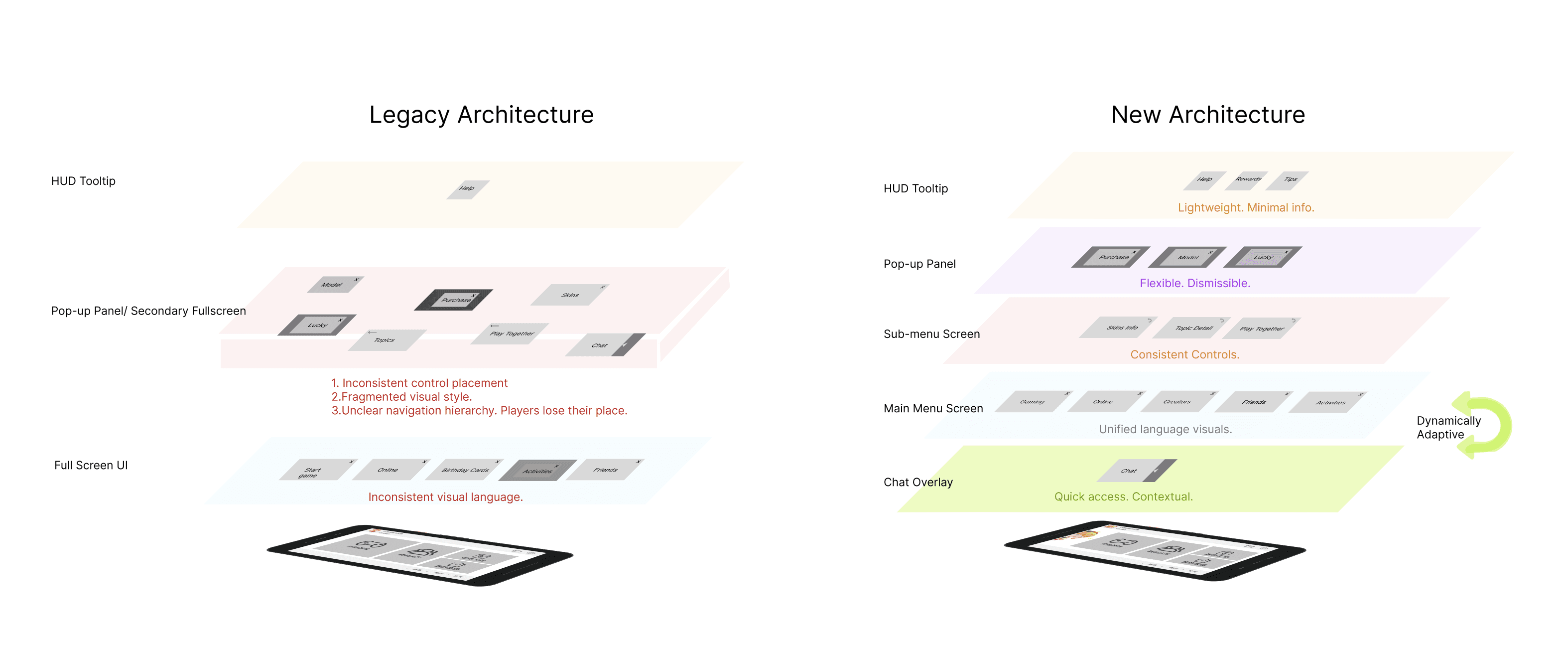
Remapped the full product's information architecture from scratch, standardizing use cases and interaction rules for full-screen views, windowed views, dialogs, and other hierarchy levels. Navigation across complex features became intuitive and predictable for the first time.
L3 — Design Language & Component System
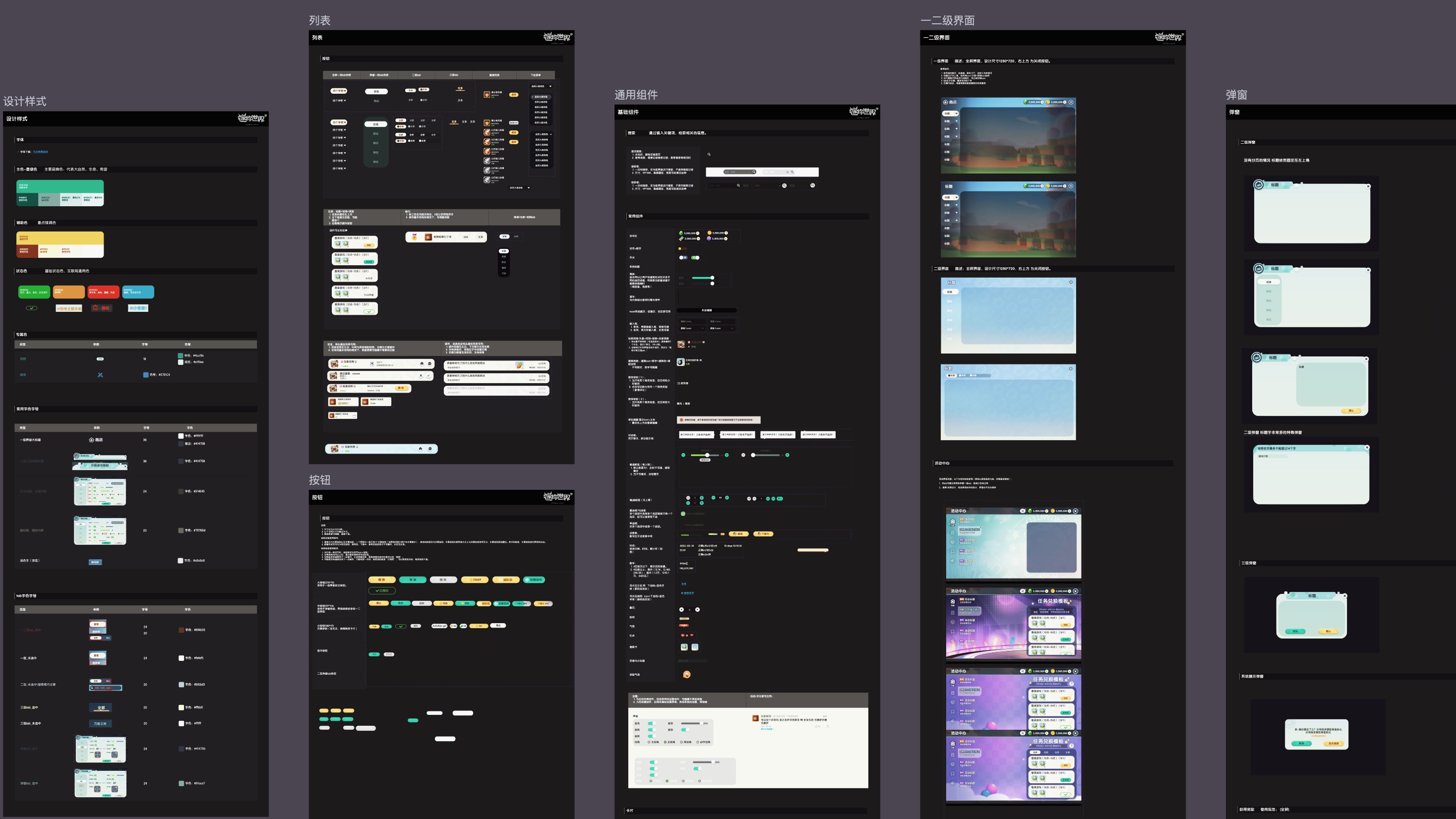
Established a unified visual design language: ——Typography, Color, Spacing, Layout — as foundational design tokens.
Decomposed all interfaces into reusable atomic components, each fully specified across visual structure, interaction behavior, and all states.
L4 — DesignOps
Built a comprehensive collaboration framework spanning design, engineering, and business. Integrated core components directly into the UI Framework codebase. Established design standards and acceptance criteria across all teams, with dedicated component ownership, versioning, and governance processes.
Key Challenges
01 — Building internal consensus on design language
Strategy:
Anchored decisions in user research to establish preference baselines. Collaborated with the visual design team to reconstruct core module visuals. Drove consensus through user testing data and multiple rounds of internal presentations.
Outcome:
New design language landed in core modules —recognized by business units and senior leadership.
02 — Cross-team adoption resistance
Strategy:
Partnered with engineering leads to jointly define core component specifications, then integrated components directly into the codebase — making adoption nearly frictionless for engineers.
Outcome:
The design system became the default starting point — not an optional add-on.
03 — System entropy and ongoing maintenance
Strategy:
Categorized components into universal and specialized types.
Established regular review cycles and designated dedicated owners responsible for the full lifecycle — design → engineering → documentation.
Outcome:
Component library continued to evolve healthily — without descending into chaos.
Reflection
01 — The design system as a long-term product capability
A design system is not a one-time deliverable — it is an infrastructure that requires sustained investment. As more modules onboarded, a flywheel effect emerged: more reuse → faster development → greater consistency → better product experience. Ultimately, the design system became one of Mini World's core product infrastructures — not just a component library, but an organizational capability.
02 — A design system is, at its core, organizational transformation
The hardest part of building a design system is not designing the components — it is changing how teams work. Success required cross-team alignment, engineering integration, and ongoing governance. Once truly established, a design system becomes the most durable long-term capability a designer can build into a product organization.